
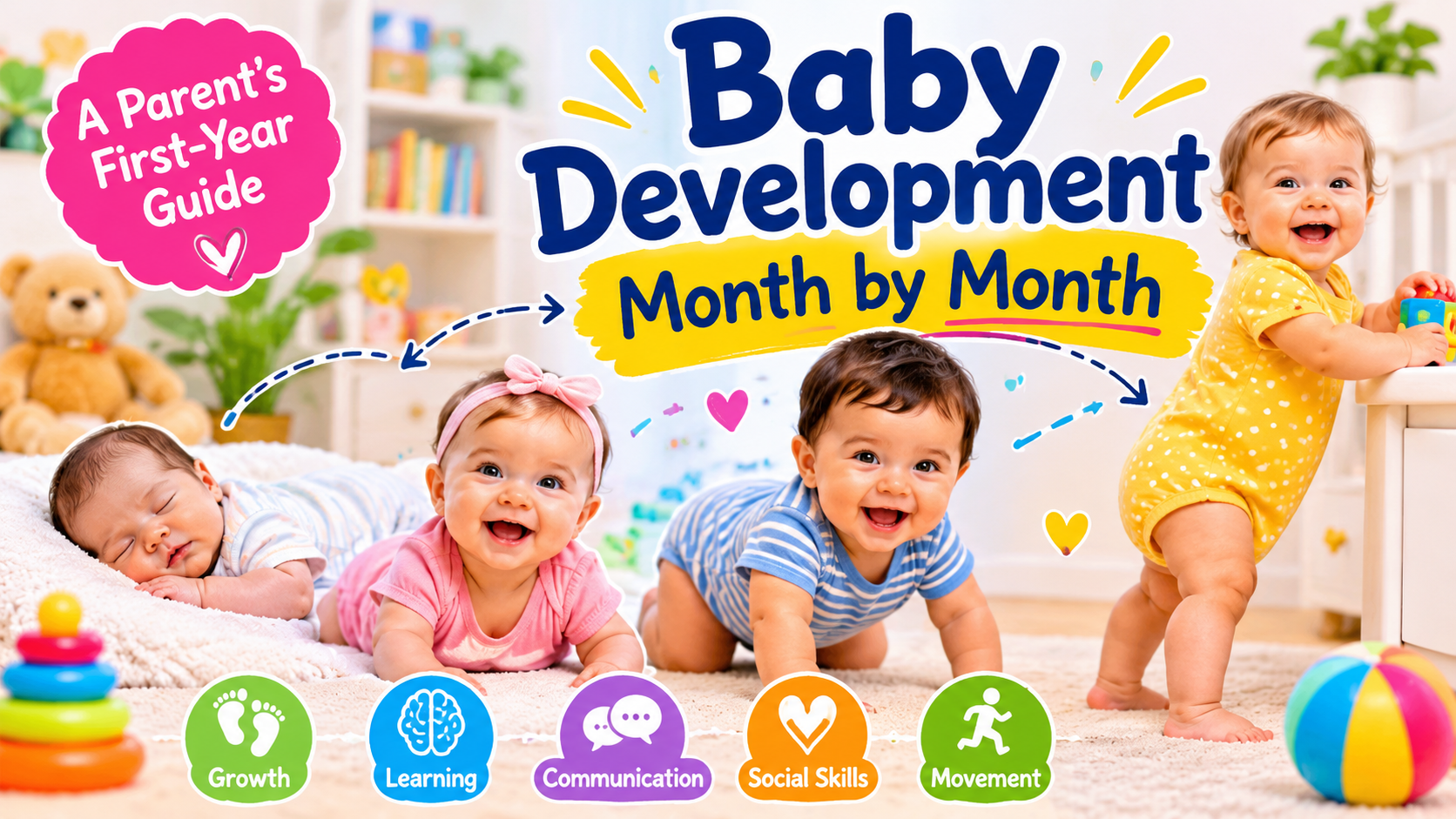
What Is Baby Development?
Baby development refers to the physical, emotional, social, language, and thinking skills that children gradually learn as they grow. During the first year, babies experience remarkable changes. They begin by depending on adults for almost everything and gradually learn to control their movements, communicate, explore, and interact with the world.
Development generally includes five main areas:
- Physical development: Growing stronger, moving arms and legs, rolling, sitting, and eventually standing.
- Cognitive development: Learning through observation, recognizing familiar people, exploring objects, and solving simple problems.
- Language development: Responding to sounds, making noises, babbling, and beginning to understand familiar words.
- Social development: Smiling, connecting with caregivers, enjoying games, and responding to people.
- Emotional development: Expressing feelings, seeking comfort, and developing a sense of security.
These areas are connected. For example, when your baby reaches for a toy, they are developing physical coordination while also learning about distance, movement, and cause and effect.
Baby Development Month by Month
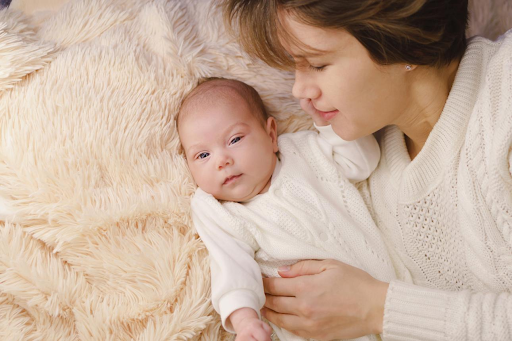
Every baby follows an individual developmental path. The following guide describes common changes parents may notice during the first 12 months. Some skills appear gradually, and not every baby will demonstrate each one at the exact month listed.
Month 1: Getting Used to the World
The first month is a period of adjustment for both baby and parents. Your newborn is becoming familiar with sounds, smells, touch, light, and the people who provide care.
Common developmental changes:
- Moves arms and legs, often with jerky movements.
- Focuses briefly on faces or nearby objects.
- Responds to familiar voices and loud sounds.
- Turns toward touch or seeks feeding.
- Sleeps for much of the day, waking regularly for feeding and care.
- Communicates mainly through crying and body movements.
How parents can support development:
- Hold and cuddle your baby regularly.
- Speak softly during feeding and diaper changes.
- Make gentle eye contact when your baby is alert.
- Provide short periods of supervised tummy time while your baby is awake.
- Follow safe sleep practices by placing your baby on their back for every sleep.
Your baby does not need complicated toys or activities at this age. Loving attention, feeding, comfort, and a safe environment are excellent foundations.
Month 2: Smiles and Early Communication
Around the second month, many babies become more responsive to the people around them. You may notice your baby looking at your face, calming when you speak, or giving you a first social smile.
Common developmental changes:
- Smiles when you talk or smile.
- Looks at your face.
- Makes sounds other than crying.
- Watches you as you move.
- Briefly holds their head up during tummy time.
- Moves both arms and legs.
How parents can support development:
- Smile and talk to your baby throughout the day.
- Respond when your baby makes little sounds.
- Sing simple songs and repeat gentle sounds.
- Show your baby a safe, high-contrast toy.
- Continue short, supervised tummy-time sessions.
These small interactions help your baby learn that communication is a two-way experience.
Month 3: Stronger Head Control and More Interaction
By the third month, your baby may seem more interested in the people and objects around them. Head control may improve, and their movements may become smoother.
Common developmental changes:
- Holds their head more steadily when supported.
- Brings hands toward the mouth.
- Follows a moving object with their eyes.
- Smiles and makes sounds during interaction.
- Shows excitement when seeing familiar caregivers.
- Enjoys looking at faces.
How parents can support development:
- Place a safe toy within your baby’s view.
- Talk about everyday activities.
- Give your baby supervised tummy time.
- Gently move a toy from side to side for them to follow.
- Pause during conversations to give your baby time to respond.
Your baby’s sounds, expressions, and movements are early ways of connecting with you.
Month 4: Laughing, Reaching, and Exploring
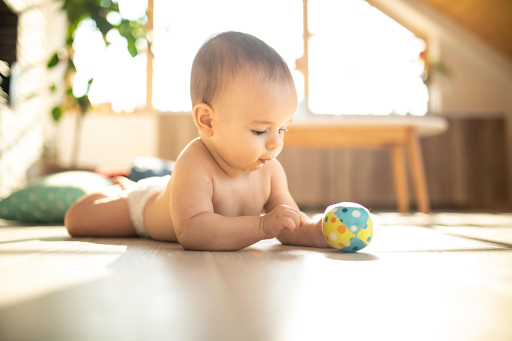
The fourth month can bring more playful interactions. Your baby may begin to laugh, show excitement when you approach, and reach toward interesting objects.
Common developmental changes:
- Smiles to get your attention.
- Chuckles when you try to make them laugh.
- Looks at you, moves, or makes sounds to keep your attention.
- Holds their head steady when supported.
- Brings hands to their mouth.
- May hold a toy when placed in their hand.
How parents can support development:
- Play simple face-to-face games.
- Offer age-appropriate toys that are easy to grasp.
- Encourage reaching during supervised floor play.
- Read short board books or describe colorful pictures.
- Give your baby plenty of opportunities to move freely on a safe floor surface.
Avoid placing small objects within reach because babies often explore by putting things in their mouths.
Month 5: Reaching, Rolling, and Discovering
At five months, many babies become more active during play. They may reach for toys, explore their hands and feet, and show growing interest in their surroundings.
Common developmental changes:
- Reaches for toys and other nearby objects.
- Rolls from tummy to back or practices rolling in other directions.
- Enjoys looking at their reflection.
- Makes more varied sounds.
- Shows excitement during familiar games.
- May begin supporting more weight through their arms during tummy time.
How parents can support development:
- Place a toy slightly out of reach to encourage movement.
- Give your baby supervised floor time.
- Talk, sing, and respond to their sounds.
- Offer safe toys with different textures.
- Keep the play area clear of small objects and choking hazards.
Not every baby rolls at the same age. Keep your baby safe by avoiding unattended time on beds, sofas, or changing tables.
Month 6: Sitting Practice and New Sounds
Six months is an exciting stage for many families. Your baby may be more interested in sitting, reaching, and interacting with familiar people. Some babies also begin exploring solid foods around this age when they show signs of readiness.
Common developmental changes:
- Knows familiar people.
- Laughs and takes turns making sounds with you.
- Reaches for a toy they want.
- Rolls from tummy to back.
- Pushes up with straight arms during tummy time.
- May lean on their hands for support while sitting.
How parents can support development:
- Offer supported sitting practice on the floor.
- Play simple turn-taking sound games.
- Provide safe toys that your baby can reach and hold.
- Continue daily supervised tummy time.
- Ask your healthcare provider whether your baby is ready to start solid foods.
Breast milk or infant formula remains an important source of nutrition during the first year. When starting solids, follow your healthcare provider’s advice and introduce appropriate textures and foods safely.
Month 7: Building Strength and Curiosity
During the seventh month, your baby may become more interested in moving toward toys and exploring objects. Some babies begin sitting more steadily, while others are still practicing.
Common developmental changes:
- Sits with less support or begins sitting independently.
- Moves toys between hands.
- Reaches for objects with more control.
- Babbles and experiments with different sounds.
- Shows interest in familiar people and everyday activities.
- Explores objects by touching, shaking, and mouthing them.
How parents can support development:
- Place toys around your baby during supervised floor play.
- Offer safe objects with different shapes and textures.
- Read picture books and name familiar objects.
- Play simple games such as hiding a toy partly under a cloth.
- Encourage movement without forcing your baby into a position.
Make sure the play space is clean, safe, and free from choking hazards.
Month 8: Sitting, Babbling, and Social Awareness
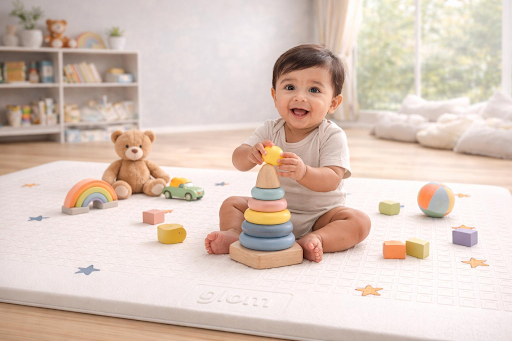
At eight months, your baby may become more aware of familiar people and surroundings. Some babies show discomfort around strangers or become upset when a parent leaves the room. These reactions can be part of typical social development.
Common developmental changes:
- Sits without support.
- Moves objects from one hand to the other.
- Uses fingers to move food toward themselves.
- Babbles with repeated sounds.
- Looks for objects that have fallen out of sight.
- May react when a familiar caregiver leaves.
How parents can support development:
- Play peek-a-boo and other simple social games.
- Give your baby safe toys to pass between hands.
- Talk about objects your baby is looking at.
- Offer comfort when your baby becomes upset.
- Allow supervised exploration in a baby-proofed area.
Responding calmly and consistently helps your baby feel secure while learning about the world.
Month 9: More Movement and Problem-Solving
By nine months, many babies are becoming more active and curious. Some crawl, shuffle, roll, or use other ways to move around. Crawling is not a required milestone for every baby.
Common developmental changes:
- Gets into a sitting position independently.
- Sits without support.
- Moves objects from one hand to the other.
- Looks for objects when they disappear from view.
- Babbles with repeated sounds such as “mamama” or “babababa.”
- May show different facial expressions and respond to their name.
How parents can support development:
- Play simple hiding games with toys.
- Encourage safe movement across the floor.
- Read books and point to familiar pictures.
- Respond to babbling as though you are having a conversation.
- Let your baby explore safe household objects made for infant play.
This is also a good time to discuss developmental progress during your baby’s health visit. Ask whether a developmental screening is due and share any concerns.
Month 10: Pulling Up and Exploring

During the tenth month, some babies begin using furniture or other stable surfaces to pull themselves into a standing position. Others focus on crawling, sitting, or improving their hand coordination.
Common developmental changes:
- Moves around by crawling, scooting, or another method.
- May pull up to stand while holding furniture.
- Uses fingers to pick up smaller objects.
- Understands some familiar words or routines.
- Enjoys interactive games.
- Shows stronger preferences for familiar people and toys.
How parents can support development:
- Make sure furniture is secured to walls.
- Provide stable, safe spaces for supervised standing practice.
- Offer toys that encourage grasping and releasing.
- Talk about everyday routines, such as getting dressed or eating.
- Play games that involve taking turns.
Do not use baby walkers with wheels. They can increase the risk of serious injuries and do not help babies learn to walk safely.
Month 11: Communication and Early Independence
At eleven months, your baby may use gestures, sounds, and facial expressions to communicate what they want. They may also become more confident moving around furniture.
Common developmental changes:
- Pulls up to stand while holding on.
- May move sideways along furniture.
- Uses gestures to communicate.
- Responds to familiar words and simple instructions.
- Enjoys copying sounds or actions.
- May show interest in feeding themselves with safe finger foods.
How parents can support development:
- Name familiar people, toys, and objects.
- Encourage simple gestures such as waving.
- Read and sing together every day.
- Offer safe opportunities for supervised movement.
- Let your baby practice self-feeding with appropriately prepared foods.
Give your baby time to try new skills. Helping is important, but allowing safe opportunities to explore is equally valuable.
Month 12: Celebrating the First Birthday
Your baby’s first birthday is a wonderful milestone for the whole family. By this age, many babies are more active, understand familiar routines, and communicate through sounds and gestures.
Common developmental changes:
- Plays simple games such as pat-a-cake.
- Waves goodbye.
- Calls a parent “mama,” “dada,” or another special name.
- Understands “no” by briefly pausing or stopping.
- Puts objects into containers.
- Looks for a toy you hide.
- Pulls up to stand and may walk while holding furniture.
- Uses their thumb and pointer finger to pick up small pieces of food.
Some babies take their first independent steps around their first birthday, while others walk later. Walking independently is not a requirement for the 12-month milestone checklist.
How parents can support development:
- Read picture books and name familiar objects.
- Play simple games that involve taking turns.
- Offer safe toys that can be placed into and removed from containers.
- Encourage standing and movement in a safe environment.
- Celebrate attempts to communicate, explore, and solve simple problems.
Your baby’s first year is about much more than reaching milestones. Every smile, sound, movement, and shared moment helps build the foundation for future learning.
Five Areas of Baby Development Parents Should Understand
Following your baby’s progress is easier when you know what the different areas of development involve.
1. Physical Development
Physical development includes muscle strength, coordination, balance, and movement. During the first year, babies gradually gain control over their heads, hands, arms, legs, and bodies.
You may notice progress through:
- Better head control.
- Reaching and grasping.
- Rolling and sitting.
- Moving around the floor.
- Pulling up to stand.
Give your baby safe opportunities to move and explore. Avoid forcing them to sit, stand, or walk before they are ready.
2. Cognitive Development
Cognitive development involves learning, remembering, exploring, and solving problems. Babies learn by watching people, touching objects, listening to sounds, and repeating actions.
You can support this area by:
- Playing peek-a-boo.
- Hiding a toy under a cloth.
- Offering safe toys to explore.
- Reading picture books.
- Describing everyday activities.
Simple play gives babies opportunities to understand how the world works.
3. Language and Communication Development
Communication starts long before a baby says their first recognizable word. Crying, eye contact, facial expressions, cooing, babbling, and gestures are all part of early communication.
Parents can encourage communication by:
- Talking to their baby throughout the day.
- Responding to sounds and gestures.
- Singing familiar songs.
- Reading aloud.
- Naming objects and people.
You do not need special lessons or expensive learning products. Everyday conversations are valuable.
4. Social and Emotional Development
Social and emotional development involves forming relationships, expressing feelings, and learning to seek comfort from trusted caregivers.
Babies gradually learn to recognize familiar people, enjoy interaction, express happiness, and respond to separation.
Support this development by:
- Responding when your baby needs comfort.
- Smiling and making eye contact.
- Playing face-to-face games.
- Keeping familiar routines when possible.
- Providing loving and consistent care.
A secure relationship with caregivers gives babies a foundation for exploring their surroundings.
5. Sensory Development
Babies use their senses to learn about the world. They listen to voices, look at faces, feel different textures, and explore safe objects with their hands and mouths.
You can encourage sensory exploration with:
- Soft, age-appropriate toys.
- Colorful picture books.
- Gentle songs and everyday sounds.
- Safe textured objects.
- Supervised play with objects designed for infants.
Always check toys for loose parts, sharp edges, and choking hazards.
Simple Activities to Encourage Healthy Baby Development
You do not need a complicated schedule to support your baby’s development. Small activities throughout the day can make a meaningful difference.
Try Supervised Tummy Time
Tummy time helps babies build strength in their neck, shoulders, arms, and upper body. Begin with short sessions while your baby is awake and gradually increase the time as they become comfortable.
Always supervise tummy time. For every sleep, place your baby on their back on a firm, flat sleep surface.
Read Together Every Day
Reading helps babies become familiar with sounds, words, pictures, and the rhythm of language. Even a few minutes with a board book can become a lovely daily routine.
Point to pictures, name objects, and allow your baby to touch the pages.
Talk and Sing
Describe what you are doing while feeding, dressing, or bathing your baby. Sing simple songs and respond to your baby’s sounds.
These interactions encourage early communication and strengthen your connection.
Play Simple Games
Games such as peek-a-boo, gentle clapping, and taking turns making sounds can encourage social interaction and attention.
Choose activities that match your baby’s age and interest. Stop when your baby becomes tired or overwhelmed.
Create a Safe Space to Explore
As your baby becomes more mobile, a safe play area becomes increasingly important. Secure furniture, cover electrical outlets, keep small objects out of reach, and use safety gates where appropriate.
A baby-proofed space gives your child more opportunities to explore while reducing preventable risks.
When Should Parents Be Concerned About Baby Development?
Children develop at different speeds, but it is important to recognize possible signs of developmental delay.
Consider discussing your concerns with your baby’s healthcare provider if your child:
- Does not seem to respond to loud sounds.
- Rarely makes eye contact or engages with familiar caregivers.
- Does not show expected progress in movement or communication.
- Has difficulty using both sides of the body.
- Does not respond to their name around the expected age.
- Loses a skill they previously had.
These examples do not automatically mean that a child has a developmental condition. They are reasons to ask for professional guidance.
Do not wait for your baby to reach a certain age if you are worried. Ask your healthcare provider about developmental screening or an evaluation. Early support can help children get the services they need.
If your baby was born more than three weeks early, ask your provider whether to use corrected age when reviewing developmental milestones.
How Often Should Babies Have Developmental Checkups?
Regular well-child visits help healthcare professionals monitor growth, development, feeding, sleep, and general health.
During appointments, your provider may:
- Measure weight, length, and head circumference.
- Ask about feeding and sleep.
- Review physical and communication skills.
- Discuss hearing and vision concerns.
- Check whether developmental screening is due.
- Recommend vaccinations and preventive care.
Bring a list of questions and mention any changes that concern you. You can also keep notes about new skills, sounds, movements, and interactions between appointments.
Common Mistakes Parents Should Avoid
Parents naturally want to help their babies learn and grow. However, trying to speed up development can sometimes create unnecessary pressure.
Keep these points in mind:
- Do not compare babies: A friend’s baby may sit, crawl, or walk earlier. That does not mean your child is falling behind.
- Do not force milestones: Give your baby time and safe opportunities to practice new skills.
- Avoid too much screen time: Babies learn best through real-world interaction, play, movement, and responsive relationships.
- Do not ignore concerns: If you notice a possible delay or loss of a skill, discuss it with a healthcare professional.
- Do not rely only on online checklists: Milestone guides are helpful, but they cannot diagnose a developmental condition.
- Do not overlook safety: As mobility increases, review your home for choking, fall, burn, and other hazards.
Frequently Asked Questions About Baby Development
1. What are the most important baby development milestones in the first year?
Important milestones include smiling at caregivers, responding to sounds, holding the head up, reaching for toys, rolling, sitting, babbling, using gestures, and pulling up to stand. Each baby develops at an individual pace.
2. When do babies usually start smiling?
Many babies begin showing social smiles by around two months. Some may smile earlier, while others take a little longer.
3. When do babies usually start rolling over?
Rolling can develop at different times. Many babies begin rolling during the middle months of their first year. Keep your baby supervised and avoid leaving them unattended on elevated surfaces.
4. When do babies start sitting independently?
Many babies begin sitting without support around the middle to later part of their first year. Some need more time to build balance and strength.
5. When do babies start crawling?
Some babies crawl during the second half of their first year, but crawling styles and timing vary. Some babies use other ways to move and may not crawl in the traditional hands-and-knees position.
6. When do babies say their first words?
Babies usually begin communicating through sounds and gestures before saying recognizable words. Around their first birthday, many babies call a parent by a special name such as “mama” or “dada.”
7. How can I help my baby’s brain development?
Talk, read, sing, play, respond to your baby’s sounds, and provide safe opportunities to explore. Loving, responsive interactions support learning and healthy relationships.
8. Should I worry if my baby is not meeting every milestone?
Not necessarily. Development varies, and milestone checklists are guides rather than strict deadlines. However, if your baby misses a milestone, loses a skill, or you have concerns, speak with your healthcare provider.
9. Do premature babies follow the same developmental timeline?
Babies born prematurely may need to be assessed using corrected age during early childhood. Ask your baby’s healthcare provider how to track development based on their birth history.
10. What is the best way to track my baby’s development?
Keep notes about new skills and discuss them during well-child visits. The CDC’s free Milestone Tracker app and printable checklists can also help parents follow developmental progress.
Final Thoughts
Your baby’s first year is a journey of learning, connection, and discovery. From the first social smile to the excitement of standing while holding furniture, every new skill represents progress.
Understanding baby development month by month can help you recognize common changes, create supportive play opportunities, and know when to ask for professional advice. Remember that your baby does not need to follow someone else’s timeline.
Focus on providing loving care, safe surroundings, healthy routines, and plenty of opportunities to interact and explore. Celebrate the little moments, keep attending regular health visits, and enjoy watching your baby grow one month at a time.
Medical Disclaimer
This article is for general educational purposes only and is not a substitute for professional medical advice, diagnosis, or treatment. Developmental milestones vary between children. Speak with your baby’s pediatrician or healthcare provider if you have questions about your child’s growth or development.
